3 hr
Bimini 4-Stop Snorkeling Adventure
Swim with reef sharks, explore iconic wrecks, and meet stingrays on this action-packed ocean tour
Reserve
Hand-picked by our editors — only the best 5 excursions from 18 reviewed.
Verified partners for every tour, free cancellation where available, and instant confirmation on every booking.
3 hr
Swim with reef sharks, explore iconic wrecks, and meet stingrays on this action-packed ocean tour
Reserve
15 hr
Cross to the Bahamas by fast ferry from Florida for a full day of beaches, culture, and Caribbean sun
Reserve
15 hr
Ferry to the Bahamas' closest island with hotel transfers, 6 hours of beach time, and optional water sports
ReservePrices from verified partners. Availability updates in real time at checkout. Free cancellation policies apply where shown.
The landmarks, rooms, and views travelers on this tour remember — all visible on a single visit.
Explore the central structural remains of the SS Sapona where tropical fish congregate in the shadows.
They complement each other; most visitors who do both call the SS Sapona the more thrilling landmark, while Turtle Rocks offers superior coral biodiversity. Whether you book a bimini snorkeling shipwreck tour or a reef excursion, both highlight the diverse Atlantic marine landscape.
| Feature | Top pick SS Sapona Wreck | Turtle Rocks |
|---|---|---|
Environment type |
Exposed historical wreck | Natural coral reef system |
Marine life focus |
Small tropical fish and baitfish | Diverse corals and reef sharks |
Depth level |
15 feet (4.5 m) | 10–20 feet (3–6 m) |
Historical significance |
High (WWI era concrete ship) | None (geological formation) |
Accessibility |
Boat charter only | Boat charter only |
Skill level |
Intermediate due to currents | Beginner to intermediate |
| See tickets → |
Verdict: Choose the bimini snorkeling shipwreck tickets if you prefer exploring unique maritime ruins, or select a reef tour if your priority is viewing active ecosystems and bimini snorkeling shipwreck tours that emphasize marine biology.
Choose your ticket, select your date, and reserve in under two minutes. Secure checkout handled by our verified partner.
Instant confirmation by email, with a mobile voucher you can save offline. No printing, no queuing at a collection desk.
Arrive at the entrance, show your voucher on your phone, and walk in. Most tickets include priority or skip-the-line access.
Practical details for your visit straight from our verified partners — hours, access, rules, and how to get there.
Wear swimwear, a rash guard for sun protection, and moisture-wicking clothing. Bring a light change of dry clothes for the return boat trip.
Keep belongings minimal. Use a small waterproof dry bag for essentials like identification and phones, as storage space on smaller excursion vessels is limited.
Underwater cameras and GoPros are ideal for documenting the bimini snorkeling shipwreck. Capture the rusted hull and vibrant marine life, but maintain a respectful distance from the structure to protect your gear.
The site is not wheelchair accessible. Participants should have moderate swimming ability and physical fitness to board the boat and enter the water via ladders.
The bimini snorkeling shipwreck is family-friendly for confident young swimmers. Life vests and appropriately sized fins are provided by most tour operators.
Most bimini snorkeling shipwreck tours include bottled water and refreshments like rum punch served after the snorkeling portion. Pack light snacks if you have specific dietary needs.
Best time to go, insider tips, nearby landmarks, and the cancellation fine print — flip through to skim what matters to you.
Flexible, no hidden fees.
Most bimini snorkeling shipwreck tour operators offer free cancellation up to 24 hours before departure for a full refund. Trips canceled due to unsafe weather or sea conditions are typically eligible for a full refund of the 0 USD entrance fee portion or rescheduling credit.
The SS Sapona ran aground off South Bimini in 1926, a concrete-hulled cargo steamer built for World War I and later repurposed as a rum-running warehouse during Prohibition. Her skeletal frame now rests in fifteen feet of water, visible from the surface and split nearly in two by a 1929 hurricane. The hull was used as target practice by American bombers during World War II, leaving jagged openings through which schools of sergeant majors and yellowtail snapper now patrol. What remains is one of the most accessible shallow wrecks in the Bahamas, its barnacle-encrusted girders rising like industrial sculpture against the pale sand floor. Bimini snorkeling shipwreck expeditions center on the Sapona but often include secondary sites along the same reef system. The wreck sits a short boat ride from Bennett's Harbour, surrounded by coral heads and turtle grass that attract green sea turtles, southern stingrays, and juvenile nurse sharks. Visibility typically exceeds sixty feet, and the site's shallow depth makes it suitable for novice snorkelers who would struggle with deeper offshore wrecks. The rusting metal acts as an artificial reef, hosting sponges, brain coral colonies, and dense clusters of baitfish that shimmer in the midday light. Charter operators favor morning departures when wind chop is minimal and the sun angle illuminates the interior chambers. The wreck's historical significance extends beyond maritime archaeology. Howard Hughes purchased the vessel in the 1930s, intending to convert her into a floating casino before abandoning the project. Decades of saltwater corrosion have reduced the superstructure to fragmented ribs and engine mounts, but the hull's original poured-concrete construction remains intact, a testament to early twentieth-century naval engineering. Underwater photographers prize the contrast between the Sapona's angular decay and the organic forms of encrusting marine life. At high tide, only the uppermost section breaks the surface, marked by seabirds that roost on the exposed beams. The site remains open year-round, accessible exclusively by private charter or multi-stop snorkel tour departing from North or South Bimini marinas.
"The hull was used as target practice by American bombers during World War II, leaving jagged openings through which schools of sergeant majors and yellowtail snapper now patrol."
A step-by-step walkthrough of the visit — what you'll see, how long each stage takes, and the details that matter.
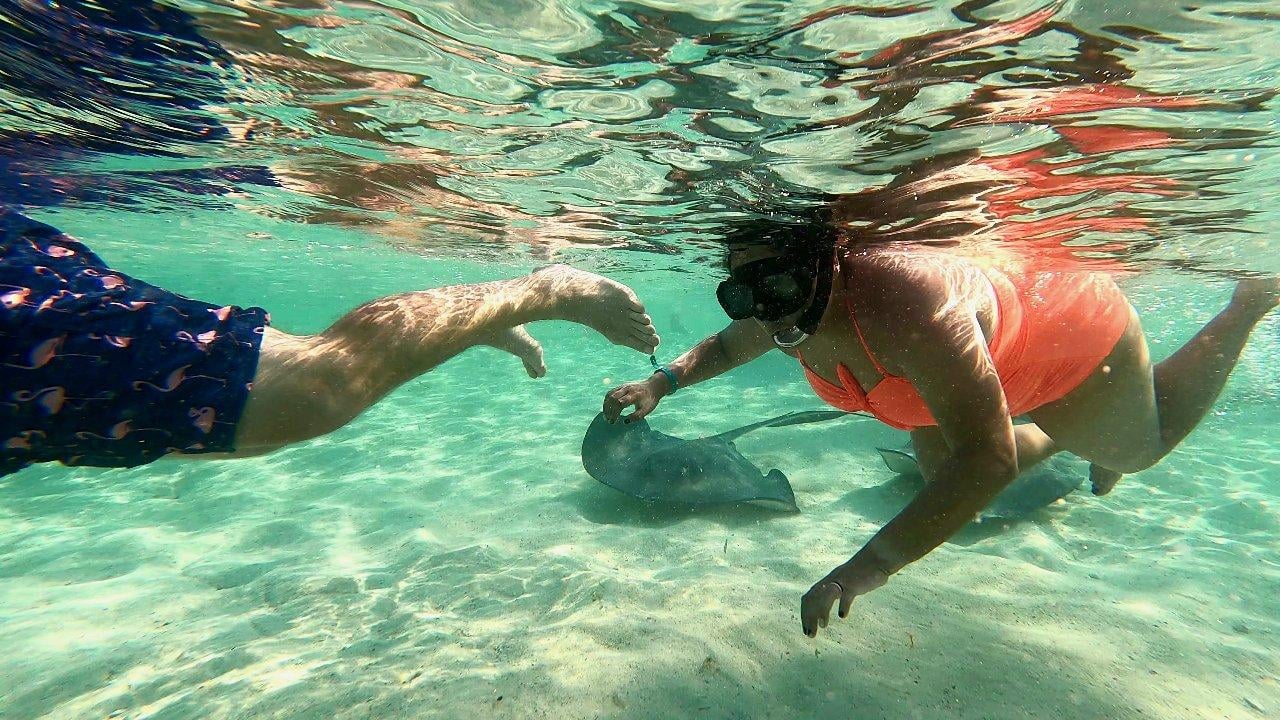
You board a center-console boat at Bailey Town marina, the captain briefing you on current conditions as the engine kicks into gear. The ride south takes twelve minutes, the Sapona's rusted silhouette growing larger against the horizon until you anchor twenty yards off her starboard side. You adjust your mask, step off the swim platform, and the wreck's full scale becomes apparent—forty feet of broken concrete stretching parallel to the reef, its interior chambers flooded and open to the sky. You fin slowly along the port side, where the hull's fractured edge descends into sand at eighteen feet. A hawksbill turtle glides past, indifferent to your presence, disappearing beneath a coral-draped overhang. You surface for air, then duck back under to explore the engine room, now a hollow cathedral where sergeant majors dart through shafts of filtered sunlight. The captain signals from the boat—ten minutes remaining. You circle the bow one final time, photographing the way sea fans cling to the propeller shaft, then return to the ladder. The boat moves on to a second site, a shallow coral garden where you drift above elkhorn formations and spot a resting nurse shark beneath a limestone ledge.
The SS Sapona Wreck is technically open 00:00–23:59, though it is only accessible via organized boat tours.
Entrance to the shipwreck site itself is 0 USD, as it is a public maritime landmark accessible by boat.
You must book a boat charter or tour, typically departing from North Bimini marinas like the Bimini Big Game Club.
Yes, bimini snorkeling shipwreck tickets must be purchased through authorized tour operators or cruise excursions.
The best arrival window is 09:00–15:00 to ensure optimal lighting and calm sea conditions.
The site is beginner-friendly with shallow water (approx. 15–20 feet), provided you are comfortable floating with provided safety gear.
Yes, many operators offer private charters for those seeking a more personalized bimini snorkeling shipwreck tour.
Most operators allow free cancellation up to 24 hours in advance, or offer credits if trips are canceled due to weather.
Yes, underwater photography is highly encouraged at this historic Bimini attraction.